
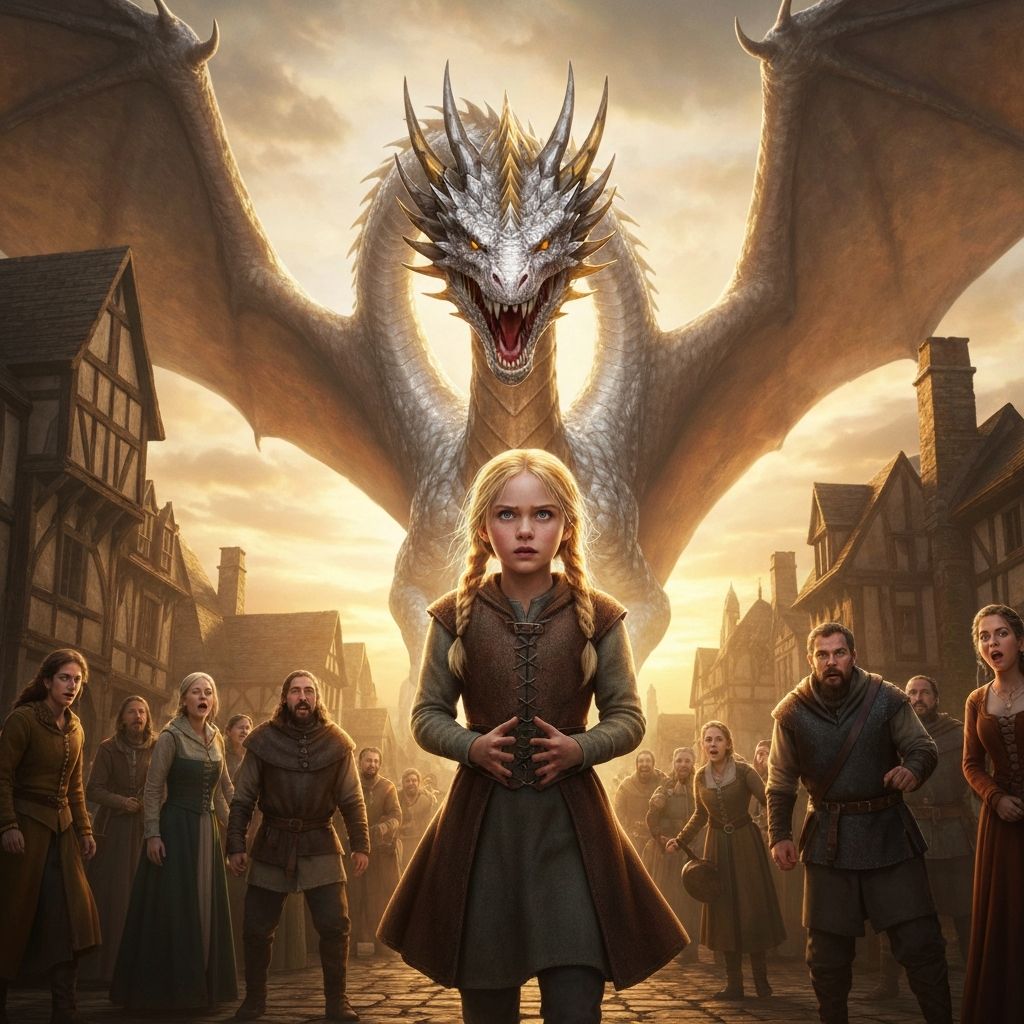
The Dragon Keeper
A young girl bonds with the last dragon, hunted by those who fear its power.
The egg was warm in Kira's hands, despite having been buried in snow for gods knew how long.
She had found it while searching for her brother's lost sheep, following tracks into a ravine that the village elders had warned her never to enter. The warnings made sense now—the ravine was littered with bones, some animal, some disturbingly humanoid, all picked clean by whatever had made this place its lair. But the lair's occupant was long gone, leaving behind only this single egg, opalescent and humming with an inner light that made Kira's fingers tingle.
She should have left it. Every story she had ever heard, every cautionary tale her grandmother had whispered by the fire, had taught her the same lesson: dragons were monsters, beasts of destruction that had nearly burned the world to ash before the heroes of old had hunted them to extinction. The last dragon had been killed three hundred years ago, its skull still mounted above the king's throne as a warning to any who might romanticize the past.
But the egg was warm. It was alive. And somewhere inside it, something stirred in response to her touch.
"I'll protect you," Kira whispered, not knowing why the words felt true. "I promise."
She carried the egg home wrapped in her cloak, hidden from her brother's curious eyes and her mother's suspicious ones. She kept it beneath her bed, wrapped in furs, feeding the fire in her small hearth until her room was warm enough to bake bread. And every night, she pressed her hands against the shell and felt the life within respond.
The dragon hatched three weeks later, on the night of the winter solstice.
Kira woke to the sound of cracking, like ice breaking on a spring river, and found her room filled with soft golden light. The shell had split down the middle, and from within emerged a creature that defied everything she had been taught to believe.
The dragon was beautiful.
It was small—smaller than a cat, small enough to curl in her cupped hands—with scales that shifted between silver and gold depending on how the light caught them. Its eyes were enormous, taking up half its face, and they were the deep violet of sunset clouds. When it looked at Kira, she felt something click into place in her mind, a connection forming that went beyond words.
"Hello," she said, and the dragon trilled a response that vibrated in her chest like a second heartbeat.
She named it Solstice, after the night of its birth, and she kept it secret for as long as she could. The dragon grew quickly, too quickly—within a month it was the size of a dog, and Kira had to move it to an abandoned shepherd's hut on the edge of her family's land. Within two months it was the size of a horse, and hiding it became a daily challenge.
But hiding it was easier than the alternative.
Kira lived in the kingdom of Valdrath, ruled by King Aldric the Third, descendant of the hero who had slain the last dragon and ushered in three centuries of peace. The Dragon Accords, signed in the ashes of the final battle, declared all dragon-kind to be enemies of civilization, their eggs to be destroyed on sight, their sympathizers to be executed as traitors. Even possessing a dragon scale was punishable by imprisonment.
If anyone discovered Solstice, both of them would die.
"I don't understand," Kira told her dragon one evening, sitting in the hut while Solstice's tail curled around her like a protective wall. "The stories say your kind burned cities, devoured children, brought darkness and terror wherever you flew. But you've never hurt anyone. You're gentle, and kind, and—"
Solstice rumbled something that wasn't quite language but that Kira understood anyway: the stories were not wrong. Dragons had done terrible things. But so had humans, and humans were not hunted to extinction for their crimes.
"What happened?" Kira asked. "Why did it all go wrong?"
The answer came in images, shared through the bond that had formed between them: ancient memories passed down through dragon bloodlines, carried in the very essence of their being. Kira saw a time before the wars, when dragons and humans had lived in harmony, when dragon-riders had protected the realm and dragon-fire had warmed winter-frozen villages. She saw the betrayal—a king who feared the dragons' power, who poisoned the nesting grounds and murdered the dragon-speakers who could have brokered peace. She saw the dragons' grief turn to rage, their protective instincts twisted into destructive fury, their gentle nature corrupted by loss.
She saw three hundred years of history rewritten by the victors, until no one remembered the truth.
"The king lied," Kira whispered. "His ancestors committed genocide, and then they blamed the victims."
Solstice's violet eyes held infinite sadness. The truth had been buried so deep that even the dragons had begun to forget. Solstice was the last, born from an egg that had somehow survived centuries of hunting, and without others of their kind, the full history was fragmentary, incomplete.
But it was enough.
Kira began to research, sneaking into the village library to study texts that most people ignored: pre-war histories, accounts that predated the Dragon Accords, fragments of dragon-speaker testimonies that had escaped the censors. The more she read, the more the official narrative crumbled. The Dragon Wars hadn't been a struggle for survival against monsters—they had been a calculated extermination of beings who had committed the crime of being too powerful, too independent, too impossible to control.
And now the king's descendants were hunting Solstice.
She didn't know how they had discovered her secret. Perhaps a shepherd had spotted the dragon flying at night, or perhaps the king's sorcerers had ways of detecting dragon magic that she didn't understand. But one morning, Kira woke to find soldiers surrounding her village, their armor bearing the silver dragon-skull sigil of the royal house.
"A dragon has been reported in this region," their captain announced to the gathered villagers. "We will search every building, every field, every hiding place. Any person found to be harboring the beast will be executed immediately. If the dragon is surrendered voluntarily, we will show mercy to the village."
Kira's mother looked at her with knowing eyes. She had never said anything, but Kira realized now that she had always known—had smelled the smoke in Kira's clothes, had seen the joy in her daughter's eyes, had chosen to keep the secret for love of her child.
"Run," her mother whispered. "Take it and run. Don't look back."
Kira ran.
She found Solstice already waiting at the edge of the forest, as if the dragon had sensed the danger before Kira had. They fled into the wilderness together, traveling by night, hiding by day, always one step ahead of the hunters who seemed to know every path, every refuge, every place a dragon might conceivably hide.
"How do they keep finding us?" Kira asked after their third narrow escape, huddled in a cave while soldiers searched the valley below.
Solstice's answer came with a taste of shame: the dragon's magic left traces, signatures that the king's sorcerers could follow. The only way to stop being tracked was to stop using magic entirely, and for a dragon, that was like asking a human to stop breathing.
"Then we can't run forever." Kira leaned against Solstice's warm flank, feeling the dragon's heartbeat sync with her own. "We have to do something else."
The plan came to her over the following days, shaped by desperation and the fragments of history she had discovered. If the king's power was built on lies, then the truth could be their weapon. If the people of Valdrath believed dragons were monsters, then they needed to be shown otherwise.
They needed to see Solstice.
"It's too dangerous," Kira argued with herself, but Solstice's response was certain: they would die running. They might as well die trying to change things.
The capital city of Valdrath sprawled across a river delta, its towers gleaming in the summer sun, its streets packed with people who had never seen a dragon and had been taught to fear their very existence. Kira and Solstice arrived at dawn on the day of the midsummer festival, when the king himself would address the crowds from the steps of his palace.
They perched on the roof of the great cathedral, hidden by its spires, watching the masses gather below. King Aldric III was a thin man with cold eyes, his crown set with gems said to be dragon's tears, his throne built from dragon bone. He spoke of peace and prosperity, of the sacrifices his ancestors had made to free humanity from the dragon threat.
Then Solstice spread their wings and dropped into the light.
The screams began immediately, as expected. People fled in all directions, soldiers drew their weapons, and the king's sorcerers began weaving spells of binding and destruction. But Solstice didn't attack. They landed in the center of the square, folded their wings, and bowed their head in a gesture of submission that no monster would have known to make.
Kira slid from Solstice's back and faced the crowd.
"The dragon hasn't hurt anyone!" she shouted, her voice carrying through the sudden silence. "It could burn this entire square if it wanted to, but it won't, because dragons aren't what you've been told. They're not monsters—they're thinking, feeling beings who were betrayed and slaughtered by the very king whose descendants now rule you!"
She pulled out the documents she had gathered, copies of pre-war treaties and dragon-speaker testimonies, and threw them into the crowd. "Read for yourselves! The Dragon Wars were a genocide, carried out by a king who feared any power he couldn't control! Every story you've been told is a lie designed to justify extinction!"
The sorcerers' spells hit Solstice then, chains of light wrapping around the dragon's body, burning into silver scales. Solstice screamed—a sound that Kira felt in her soul—but didn't fight back, didn't use the fire that could have turned the sorcerers to ash.
"Look at them!" Kira cried. "They're being tortured, and they're choosing not to hurt anyone! Is that the behavior of a monster?"
The crowd was no longer fleeing. They were watching, seeing a dragon for the first time, seeing it suffer without striking back. Kira saw doubt in their eyes, confusion, the first cracks in three centuries of propaganda.
"Enough."
The king's voice cut through the chaos. He stepped forward, his sorcerers parting before him, his cold eyes fixed on Kira with a hatred that confirmed everything she had discovered.
"You think the truth matters?" Aldric asked, his voice pitched for the crowd. "You think these people care about what happened three hundred years ago? Dragons are powerful. Humans are not. That is the only truth that matters, and it is why dragons must die."
"We're not enemies," Kira said. "We never had to be enemies."
"Power cannot be shared." The king raised his hand, and the sorcerers' spells intensified. Solstice's screams grew louder. "It can only be wielded or destroyed. Your dragon will die today, and you will die with it, and the people will remember nothing except that the monsters were vanquished once more."
But he had miscalculated. He had expected the crowd to celebrate, to cheer the destruction of their ancient enemy. Instead, they were quiet, watching, and some of them were reading the documents Kira had thrown. Some of them were looking at Solstice's suffering with something other than fear in their eyes.
Compassion.
One person stepped forward—a blacksmith, Kira would later learn, a man who had lost his daughter to the king's taxes and his faith in the crown long before today. "Let the dragon go," he said.
Others joined him. Then more. Then dozens, then hundreds, a human wall between the sorcerers and their target, ordinary people who had glimpsed a different truth and chosen to stand for it.
The king's face contorted with fury. "This is treason!"
"No," Kira said, standing with the people who had chosen to protect her dragon. "This is humanity."
The revolution that followed was neither quick nor bloodless. King Aldric III did not surrender his power easily, and many who had stood in that square died in the fighting that came after. But the truth, once spoken, could not be unspoken. The old documents were copied and distributed, dragon-speaker descendants came forward with oral histories passed down through generations, and slowly, painfully, Valdrath began to reckon with its past.
Solstice survived. More than survived—they became a symbol, proof that coexistence was possible, that fear was not the only response to power different from one's own. Other dragons were discovered over the following years, hidden eggs that had escaped the genocide, and each one was welcomed rather than destroyed.
Kira became the first dragon-speaker in three hundred years, teaching others the art of bonding that her ancestors had practiced. She never forgot the day she had stood in the square, terrified and determined, or the moment when ordinary people had chosen to see past their fear.
And every midsummer, on the anniversary of that choice, Solstice would fly above the city—no longer the capital of a kingdom but of a new republic—and the people would look up not with terror but with wonder.
Dragons were not monsters.
They never had been.
They were family, long separated by lies and fear, finally brought home again.