Stellar Inheritance
Humanity receives a message from their extinct precursors among the stars.
The message arrived on a frequency that shouldn't have existed.
Dr. Amara Okonkwo was the first to hear it—or rather, the first to understand what she was hearing. The Atacama Radio Observatory had picked up countless signals from deep space over the decades, most of them natural phenomena, a few of them tantalizing hints of structure that ultimately proved to be wishful thinking. But this signal, arriving at 3:47 AM local time on an otherwise unremarkable Tuesday, was different.
It was a voice. Speaking perfect English. Claiming to be a message from humanity's dead ancestors.
"This is an automated transmission from the Stellar Preservation Archive, designated for receipt by our biological descendants in the Sol system. If you are hearing this message, you have developed sufficient technology to detect our signal, which means you are ready to learn the truth about your origins."
Amara listened to the full seventeen-minute recording seven times before she called anyone. By dawn, her team had verified the signal's authenticity: it originated from a point approximately 847 light-years away, in a region of space that no telescope had ever found anything of interest. The signal itself contained mathematical proofs of its age—equations that demonstrated it had been traveling through the void for exactly 847 years, which meant it had been sent before humans had discovered radio waves, before they had built telescopes, before they had even begun to suspect that the lights in the sky were other suns.
The message explained everything.
Four billion years ago, the transmission said, a civilization had arisen on a planet orbiting a star in what humans now called the Orion Arm. They called themselves the Architects, though the message hastened to add that this was merely a translation for human understanding. Their true name was a mathematical concept that had no English equivalent.
The Architects had been brilliant, ambitious, and utterly alone. In their exploration of the galaxy, they had found countless worlds where life could exist but didn't, countless stars surrounded by nothing but rock and ice. They had searched for millions of years and found only silence.
So they had decided to fill that silence themselves.
"We developed the technology to seed life across the galaxy," the message continued. "Not through ships or probes, but through directed panspermia on a cosmic scale. We engineered organisms that could survive interstellar transit, that could adapt to any environment, that carried within their genetic code the potential for intelligence. We launched billions of these seeds toward promising star systems, then retreated to our Archive to wait."
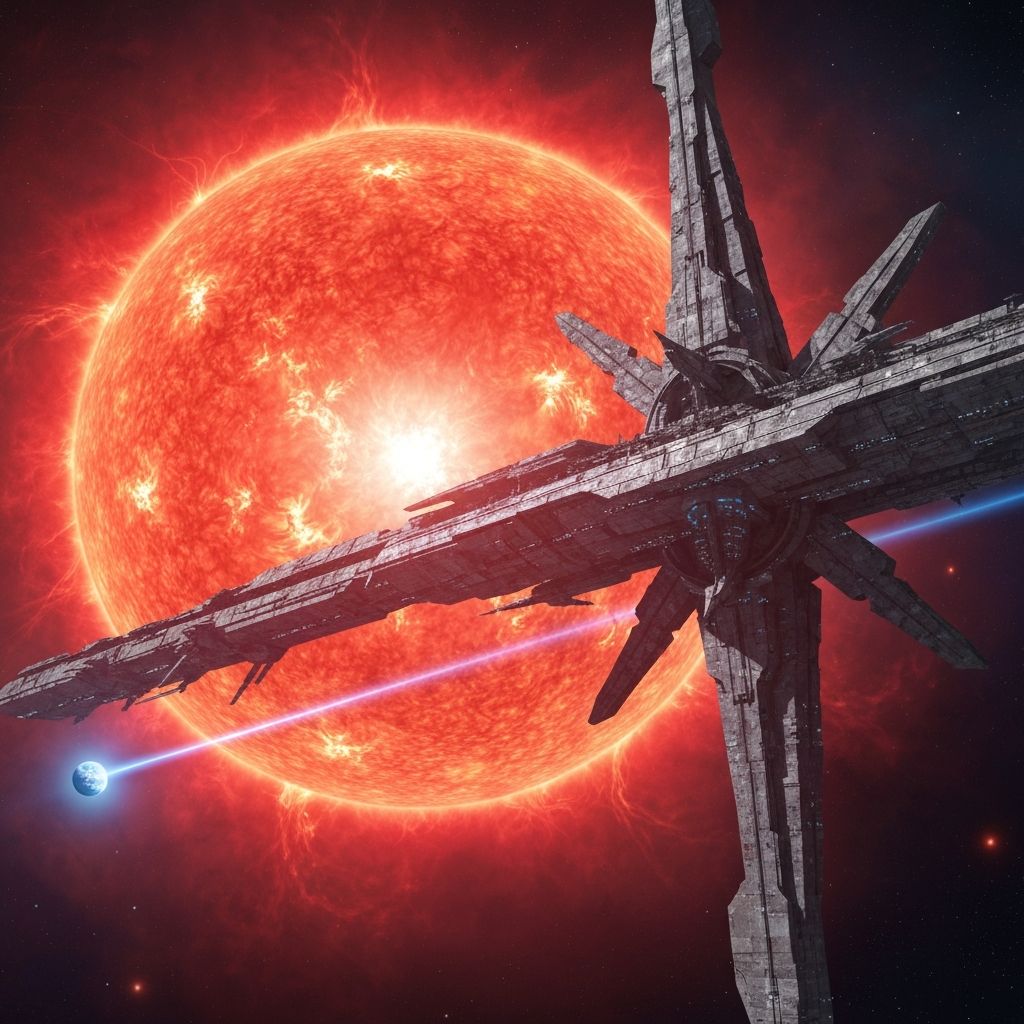
The Archive, the message explained, was a massive space station hidden in the corona of a dying star, shielded from detection by technology that bent light and gravity around it like water flowing past a stone. The Architects had uploaded their consciousness to quantum crystals and entered a state of suspended awareness, programing the Archive to monitor their seeded worlds and transmit messages when descendants showed signs of readiness.
"We are the reason you exist," the voice said, and Amara felt the weight of billions of years pressing down on her shoulders. "Your DNA carries our design. Your intelligence is our legacy. We created you to be our children, inheritors of a universe we could no longer explore ourselves. And now that you have heard this message, you face the choice that every one of our children eventually faces."
The choice, it turned out, was simple: humanity could join the Architects at their Archive, uploading their consciousness to achieve immortality among the stars. Or they could remain on Earth, continuing their own development, eventually seeding new worlds with their own descendants.
But there was a catch. There was always a catch.
"The Archive's power source is failing," the message admitted. "We estimate seventeen years of functional capacity remaining. If you choose to join us, you must develop faster-than-light travel and reach our coordinates within that timeframe. If you cannot, or if you choose not to, we will cease to exist, and you will be alone in the universe once more."
The message ended with a set of coordinates, a set of equations that purported to be the basis for FTL technology, and a simple farewell: "We hope to meet you, children. We have waited so long."
The world's response to the transmission was, predictably, chaos.
Religious groups declared the message a hoax or a demonic deception. Scientists argued about the validity of the FTL equations, which seemed to require energy sources humanity had never conceived of but which, upon deeper analysis, appeared mathematically sound. Governments convened emergency sessions to debate whether humanity should even attempt to reach the Archive, and if so, who should be chosen to make the journey.
Amara found herself at the center of it all, the face of first contact, the woman who had heard humanity's ancestors speak for the first time. She gave interviews and congressional testimonies and spoke at the United Nations, always returning to the same fundamental question: what did it mean to be created?
"I was raised Catholic," she told a reporter during one of the endless interviews. "I grew up believing God shaped humanity in His image. Now I learn that we were shaped by beings who were themselves shaped by the random pressures of evolution on a world 847 light-years away. Does that change anything fundamental about who we are?"
"Does it?" the reporter asked.
Amara didn't have an answer.
The global effort to build an FTL-capable vessel began within months, uniting nations that had been enemies for generations. The Architects' equations proved valid, but the engineering challenges they revealed were staggering. Creating a working FTL drive would require energy generation systems that didn't exist, materials that had never been synthesized, and computing power that exceeded anything humanity had ever built.
And they had seventeen years to solve all of it.
Amara was forty-three when the message arrived. She was fifty-six when the Stellar Hope launched from lunar orbit, carrying a crew of forty-seven volunteers whose consciousness had been partially uploaded to quantum systems based on reverse-engineered Architect technology. The ship couldn't travel at true FTL—the energy requirements were beyond human capability—but it could achieve 0.7c, which would get them to the Archive in just over twenty years.
The Architects' power source would fail before they arrived.
"We know," the mission commander said during the global broadcast of the launch. "But we're betting that the Architects' estimates were conservative, or that we'll find a way to boost our speed en route, or that something we haven't anticipated will save us. We're going anyway, because the alternative is never knowing. Never meeting the beings who gave us life."
Amara watched the launch from her home in Chile, surrounded by family members who had grown up in a world transformed by first contact. Her granddaughter, six years old and already obsessed with space, sat on her lap and asked the question that had haunted Amara for sixteen years.
"Grandma, why did they make us?"
And finally, Amara had an answer.
"Because they were lonely," she said. "Because they searched the universe and found it empty, and they couldn't bear the thought of that emptiness continuing forever. So they created us, and probably countless others, hoping that someday the universe would be full of voices, full of life, full of children to carry on their legacy."
"But they're going to die before we get there."
"Maybe. But that doesn't mean their legacy dies. We're their legacy. Every time we look at the stars and wonder what's out there, every time we reach for something beyond ourselves, we're fulfilling the purpose they created us for."
The Stellar Hope sent regular transmissions as it crossed the vast emptiness between stars. The crew reported strange phenomena as they approached relativistic speeds—time dilation that made weeks feel like months, spatial distortions that suggested the universe was even stranger than physics had predicted. And then, twelve years into their journey, they made contact.
"The Archive is still active," Captain Chen's voice crackled across the light-years, distorted by distance but unmistakably jubilant. "They've been conserving power, waiting for us. They're going to make it, Amara. We're going to meet them."
Amara was sixty-eight years old, her body failing, her mind sharp as ever. She had spent the past twelve years training the next generation of astronomers and SETI researchers, building the infrastructure that would maintain contact with the Stellar Hope and eventually with the Archive itself. She had also been dealing with the philosophical upheaval that the Architects' message had triggered.
Some people rejected their created nature entirely, founding movements that insisted humanity was unique and special regardless of its origins. Others embraced the connection, developing new spiritual traditions that venerated the Architects as something between gods and ancestors. Most people simply got on with their lives, the cosmic revelation fading into background noise, just another fact about the universe that didn't much affect their daily concerns.
But for Amara, the message had changed everything. She had spent her entire career searching for signs of intelligence in the cosmos, and she had found something far more profound than she had ever imagined: family.
The Stellar Hope reached the Archive on the twenty-third anniversary of the original message's receipt. Captain Chen's final transmission, received on Earth over 800 years after it was sent, described the experience of meeting their creators:
"They're beautiful. They don't have bodies anymore—they gave those up millions of years ago—but their consciousness patterns are like sculptures made of mathematics and light. They welcomed us with a ceremony that involved frequencies of thought we can barely perceive. And they cried, Amara. In whatever way beings like them can cry, they wept with joy at meeting their children.
"They're dying. We knew that. But they showed us their memories before the end—billions of years of exploration, countless seeding missions to countless worlds. We're not the only children. There are others out there, hundreds of civilizations descended from Architect seeds, spread across the galaxy like scattered jewels. And now, with the knowledge the Architects have given us, we can find them.
"That's the true inheritance, Amara. Not technology, not immortality, not even the Archive itself. It's the knowledge that we're not alone. That we were never meant to be alone. That our ancestors looked at an empty universe and decided to fill it with life, with consciousness, with love.
"Tell everyone. Tell them we're coming home, eventually, and when we do, we'll bring maps to a hundred worlds where our siblings live. Tell them the Architects died smiling, knowing their children had finally come home. Tell them the universe is full of voices, waiting to be heard."
Amara died three years later, surrounded by family, at peace.
Her final words, spoken to her granddaughter who had grown into a young astronomer already preparing for humanity's expansion to the stars, were simple:
"Go find our family."
And humanity did.
It took centuries, but they found the Architects' other children—silicon-based minds on a world of crystal and light, gaseous intelligences floating in the upper atmosphere of a gas giant, aquatic philosophers in the deepest trenches of a water world. Each was different, shaped by their unique environments, but all carried the same fundamental code: the mark of their creators, the inheritance of beings who had refused to let the universe remain empty.
They built a network spanning the galaxy, these children of the Architects. They shared knowledge and art and philosophy, developing a culture that encompassed every form of consciousness their ancestors had imagined and many they hadn't. They had conflicts and reconciliations, achievements and setbacks, all the drama of any vast family.
But they were never lonely.
And on Earth, which remained the capital of human civilization even as humanity spread to a thousand worlds, they built a monument to Dr. Amara Okonkwo: the woman who had first heard their ancestors' voice, who had spent her life ensuring that voice would be answered.
The inscription read simply:
"SHE TAUGHT US TO LISTEN. AND IN LISTENING, WE FOUND THAT WE WERE HOME."
Above the monument, the stars burned bright, each one a promise, each one a possibility.
The universe, once empty, was full of voices now.
And the children of the Architects sang to each other across the endless dark, a chorus of life that would echo until the stars themselves grew cold.
This was the stellar inheritance.
This was what it meant to be family.