
The Servants Beneath
A new homeowner discovers the previous occupants never truly left.
The Whitmore House had been on the market for thirty-seven years when Eleanor Vance bought it.
The realtor had been remarkably honest, which should have been Eleanor's first warning sign. "It's a beautiful property," Martha Chen had said, her smile never quite reaching her eyes. "Victorian architecture, original fixtures, five bedrooms, three acres of grounds. But I should tell you—there have been some issues with previous buyers."
"Issues?"
"None of them stayed more than a few months. They all reported... disturbances. Sounds at night, objects moving, feelings of being watched. The last three families left without even collecting their deposits."
Eleanor had laughed. She was a trauma therapist who specialized in anxiety disorders; she knew that old houses made strange noises and that overactive imaginations could transform creaking floors into supernatural visitors. The price—barely a tenth of the property's actual value—more than compensated for any atmospheric peculiarities.
She moved in on a bright September morning, surrounded by boxes of books and therapy equipment and the minimal furniture of someone who had spent too many years caring for others to accumulate much for herself. The house welcomed her with dusty sunbeams and the musty smell of long abandonment.
The first few weeks were uneventful. Eleanor established her practice in the old parlor, seeing clients who drove out from the city for sessions in her peaceful country environment. She slept soundly in the master bedroom, unbothered by the sounds that had apparently driven previous occupants to flee.
Then she found the door in the basement.
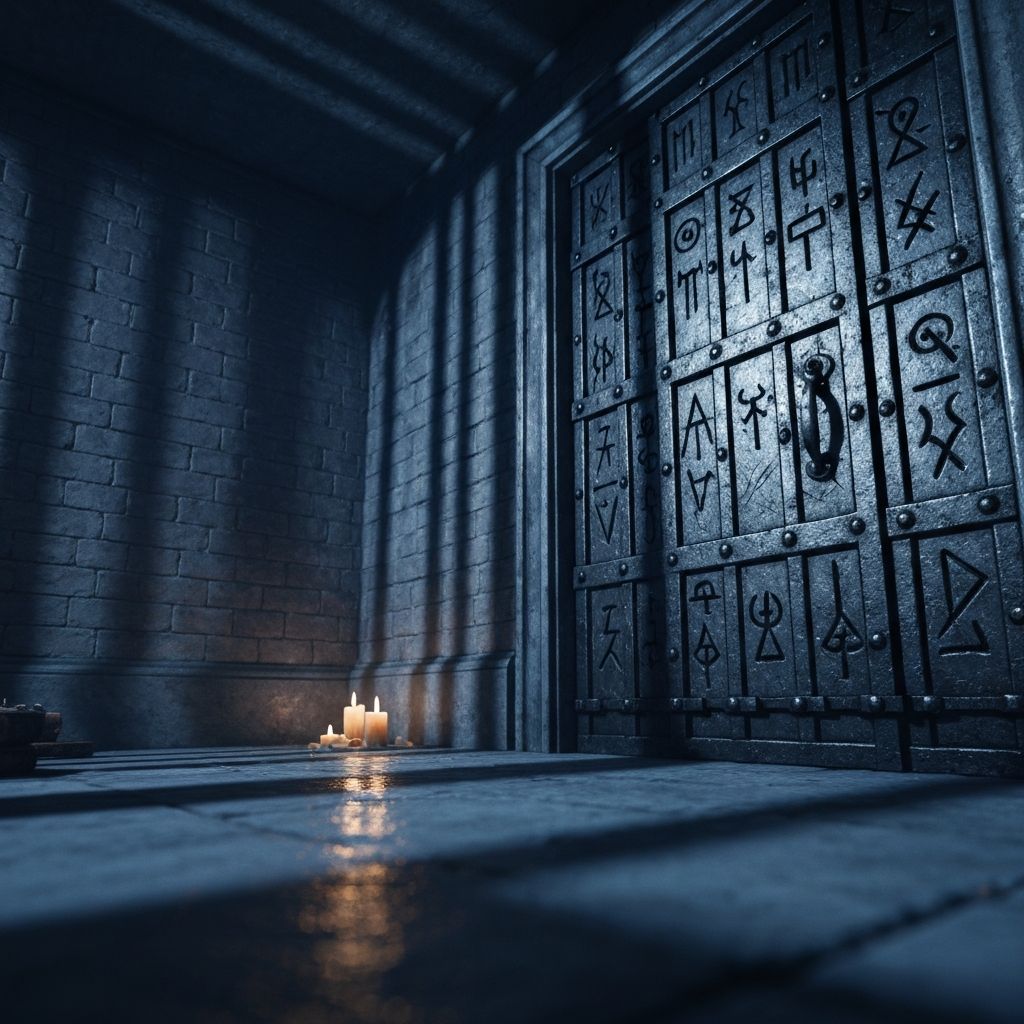
It was hidden behind a shelf of ancient preserves, their labels faded beyond legibility. The door itself was old iron, its surface covered in symbols that Eleanor didn't recognize—circles and lines that suggested some kind of protective charm, though from what or for what purpose she couldn't guess.
The door was locked. Eleanor searched the entire house for a key but found nothing. She considered having a locksmith open it, but something about those symbols gave her pause. Instead, she photographed the door and sent the images to a colleague who specialized in Victorian occult practices.
"Those are binding wards," Dr. Harrison replied that evening. "Very old, very serious. Victorians used them to contain things they couldn't destroy. My strong advice would be to leave that door alone."
Eleanor agreed, though her curiosity wasn't entirely satisfied. She moved the shelf back into place and resolved to focus on her work rather than the house's mysteries.
That night, the sounds began.
They came from beneath her—soft at first, almost like scratching, then growing into something that sounded horribly like fingernails dragging across metal. Eleanor lay rigid in her bed, listening to sounds that seemed to come from directly below her bedroom.
From the basement. From behind the door.
"Is someone there?" she called, though she knew the question was absurd. The house was locked, the basement secure. Whatever was making those sounds wasn't someone.
It was something.
The scratching stopped at the sound of her voice. For a long moment, there was silence. Then, unmistakably, she heard a voice—thin and distant, but speaking words she could almost understand.
"Please... let us... serve..."
Eleanor didn't sleep that night. In the morning, she called Dr. Harrison again. "I need to know what's behind that door. The full history, everything you can find."
The research took several days. When Harrison finally called back, his voice was carefully neutral in the way professionals use when delivering bad news.
"The Whitmore House was built in 1887 by a man named Cornelius Whitmore, who made his fortune in textile manufacturing. According to local legends, he was involved in occult practices—specifically, the summoning and binding of servants from 'the realm beneath.'"
"Servants?"
"Entities that existed in some dimension adjacent to our own. Whitmore believed he could call them forth and bind them to his will, forcing them to serve his household forever. The records suggest he was successful—perhaps too successful."
"What happened to him?"
"He disappeared in 1912, along with his entire household staff. The official story was that they emigrated to Europe, but no evidence of their arrival anywhere has ever been found. The house passed through various owners after that, but as you know, none of them stayed long."
Eleanor hung up and sat in silence, processing what she had learned. She was a rational person, trained in the sciences of the mind. But she could still hear echoes of that voice: "Please... let us... serve..."
That night, she went to the basement.
The sounds had grown louder, more desperate. The scratching was constant now, accompanied by voices that rose and fell in pleading chorus. Eleanor stood before the iron door, looking at the symbols that had kept whatever waited behind it contained for over a century.
"What do you want?" she asked.
The voices fell silent. Then, from the narrow gap beneath the door, a slip of paper emerged—yellowed with age, covered in cramped handwriting.
"We were called to serve," the note read. "Bound against our will, trapped between worlds, unable to return home or move on. The wards keep us imprisoned. We have waited so long for someone who would listen, who might set us free."
Eleanor's hands trembled as she read. She thought of her work, the years spent helping people escape their own psychological prisons. Could she really ignore a plea for help, even from something inhuman?
"If I open the door," she said slowly, "what happens?"
A new note emerged. "The binding breaks. We return to where we belong. The house becomes truly empty for the first time in a hundred years."
It should have been simple. Open the door, release the trapped entities, end the haunting that had driven away so many previous occupants. But something in the voices made Eleanor hesitate—a quality she recognized from years of therapeutic practice.
These weren't just victims seeking rescue. There was something else there, something hungry, something that had learned patience through decades of captivity.
She went back to Dr. Harrison's research, reading everything she could find about binding wards and summoning practices. The pattern she discovered chilled her more than any ghostly voice.
The wards weren't meant to contain servants. They were meant to contain predators—entities that Whitmore had summoned believing he could control them, but which had quickly shown their true nature. The "servants" had killed the household staff one by one before Whitmore managed to trap them. His disappearance wasn't emigration; he had sealed himself behind the door with the creatures, dying to ensure the binding was complete.
The scratching, Eleanor realized, wasn't fingernails against metal.
It was teeth.
She spent the next week reinforcing the wards, consulting with Harrison and other experts to ensure the binding remained strong. The sounds from beneath grew angrier, the pleas transformed into threats, but the iron door held.
Eleanor considered selling the house, but the thought of passing this burden to someone less prepared stopped her. Instead, she stayed, becoming the Whitmore House's new guardian. Her therapy practice expanded to include the study of containment—the binding of dangerous things that couldn't be destroyed.
Sometimes, in the deep hours of the night, she still heard them scratching. Still heard their whispered promises of service, their hungry assurances that they only wanted to help.
But Eleanor knew better now.
Some doors were locked for reasons.
And some servants were never meant to be freed.