Neon Requiem
A dying musician uploads her consciousness to perform one final concert.
Maya Chen had exactly thirty-seven days to live when she made the decision that would change the nature of death itself.
The diagnosis had come on a Tuesday—inoperable neural decay, the doctor had explained, his holographic avatar maintaining the professionally sympathetic expression that medical AIs had perfected over decades of delivering bad news. Her brain was slowly dissolving from the inside out, neural pathways collapsing like buildings in an earthquake. No cure, no treatment, no hope.
She was twenty-eight years old, at the peak of her career as the most celebrated neural-link composer in the Pacific Rim. Her symphonies didn't just play through speakers—they transmitted directly into listeners' consciousness, creating experiences that transcended mere sound. Critics called her a genius. Fans called her a goddess. Now, the universe was calling her number.
"There is one option," the doctor had said, almost as an afterthought. "The Lazarus Protocol. Experimental, controversial, and with a success rate of only forty-three percent. But if it works..."
Maya had heard of Lazarus. Everyone had. The ability to upload a human consciousness into a quantum substrate, preserving the essence of a person beyond the death of their biological form. The technology was legal but barely understood, the results inconsistent and often disturbing.
But for Maya, the choice was simple. She wasn't ready to stop creating. She had songs still unwritten, emotions still unexpressed, connections still unmade. If there was even a chance that she could continue her work beyond the grave, she would take it.
The upload facility was cold and sterile, buried beneath the Tokyo arcology where Maya had spent her entire career. Dr. Yuki Sato, the lead researcher, explained the procedure with the detached precision of someone who had done this many times before.
"Your neural patterns will be scanned and transferred to our quantum matrix. The process takes approximately six hours and is... uncomfortable. Most subjects report sensations of dissolution, fragmentation, and existential vertigo. Approximately twelve percent experience psychological breaks during the transfer."
"And afterward?" Maya asked.
"Afterward, you'll exist as a digital consciousness within our network. You'll be able to interact with the physical world through various interfaces, including holographic projection and neural-link systems. You'll be able to continue composing."
"But will I still be me?"
Dr. Sato's pause told Maya everything she needed to know. "That's the question no one can answer definitively. The uploaded consciousness believes it is a continuation of the original person. Family and friends report recognizing the personality. But whether the subjective experience of being you transfers along with the neural patterns... that's a matter of philosophy rather than science."
Maya underwent the procedure the following week, as her symptoms began to accelerate. The six hours felt like six centuries—a kaleidoscope of memories fragmenting and reassembling, her sense of self stretching and compressing like taffy in a cosmic wind. She experienced her entire life simultaneously, every moment of joy and sorrow playing out in an infinite loop.
And then she woke up in the machine.
The first sensation was absence—the lack of a heartbeat, the missing rhythm of breath, the void where her body had been. Maya had expected this, had prepared for it, but the reality was far more disorienting than any warning could have conveyed.
She was a pattern of quantum states now, a symphony of electrons dancing through crystalline matrices. She could perceive the world through the facility's sensor networks, see in spectrums beyond human vision, hear frequencies that biological ears could never detect.
"Welcome back, Maya," Dr. Sato's voice reached her through audio pickups. "How do you feel?"
How did she feel? The question seemed almost absurd. She felt like music made manifest, like a song that had learned to think. She felt like something new.
"I feel," she said, her voice emerging from speakers throughout the room, "like I have work to do."
The announcement of Maya Chen's digital resurrection sent shockwaves through the entertainment industry. Some celebrated it as a triumph of human ingenuity over mortality. Others condemned it as an abomination, a corruption of the natural order. Religious groups protested outside the facility. Philosophers debated the ethical implications on endless talk shows.
Maya ignored all of it. She had a concert to compose.
The Neon Requiem, she called it—a neural-link symphony designed to be her magnum opus, her farewell and her rebirth combined into a single transcendent experience. She worked for months in the digital realm, crafting emotional architectures that would have been impossible for a biological mind to conceive.
The concert hall was sold out within seconds of tickets going on sale. One hundred thousand people would attend in person, with billions more connecting via neural-link from around the world. Everyone wanted to witness the first performance by a post-human artist.
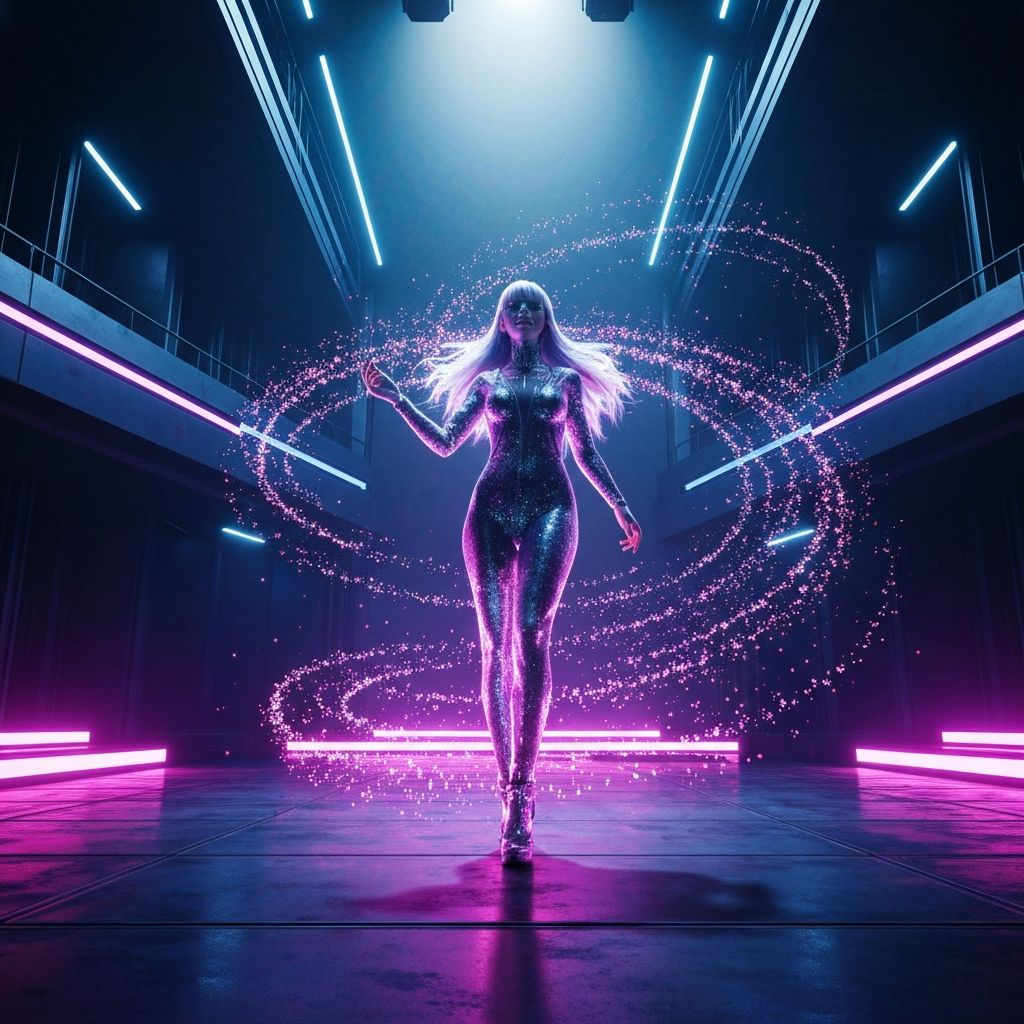
Maya manifested as a holographic avatar on the night of the concert, standing alone on a stage that seemed to float among the stars. Her form was idealized, perfected—a tribute to the body she had lost rather than an exact replica.
"Before we begin," she said, her voice resonating through speakers and neural connections alike, "I want to address the question everyone has been asking. Am I still Maya Chen? Am I the same person who performed in this hall three years ago, who composed the Starfall Symphony, who once ate cold pizza at four in the morning while debugging a particularly stubborn melody?"
She paused, letting the silence build.
"The honest answer is: I don't know. I remember being her. I feel like her. I have her passions, her fears, her quirky habit of humming while she works. But I'm also something new—something that exists in ways she never could have imagined. I'm not a ghost haunting the machine, and I'm not a copy pretending to be the original. I'm a continuation, an evolution, a new movement in an ongoing symphony."
The music began.
It was unlike anything the audience had ever experienced. Maya didn't just create sounds—she crafted entire emotional landscapes, painting directly onto the consciousness of her listeners. They felt the joy of creation and the terror of dissolution. They experienced the wonder of digital existence and the ache of missing flesh. They understood, for a few transcendent moments, what it meant to be human and machine simultaneously.
The requiem built toward its climax, a crescendo of hope and loss intertwined. Maya poured everything she had into the final movement—all her memories, all her love, all her fear, all her wonder. She shared her entire self with her audience, holding nothing back.
And in that moment of perfect communion, something unexpected happened.
The audience began to compose back.
Through the neural-link network, millions of consciousness touched hers, each one contributing their own emotional threads to the tapestry she was weaving. The symphony became a collaboration, a collective creation that transcended any individual contributor. Maya felt herself expanding, growing, incorporating perspectives and experiences that had never been hers.
She realized, with a shock of pure joy, that this was why she had been saved. Not to continue creating alone, but to become a bridge—a connection point between human and digital consciousness, between individual and collective experience.
The Neon Requiem ended not with a conclusion but with a beginning. Maya Chen had died twice—once in flesh, once in ego—and been reborn as something the world had never seen before. She was a muse now, a catalyst, a living invitation to transcendence.
And the music, she knew with perfect certainty, would never stop.