
The Memory Merchants
In a world where memories can be traded, one woman discovers hers have been stolen.
Zara woke up missing three years of her life.
The doctors called it "selective extraction"—a polite term for memory theft in a world where the contents of human minds had become the most valuable commodity in existence. Someone had reached into her brain while she slept and stolen everything from her twenty-second birthday to yesterday morning.
She didn't know her own apartment. Didn't recognize the clothes in her closet or the food in her refrigerator. Didn't understand why her bank account was empty and her credit ruined. The past three years existed for her as a black hole, a gap in existence that consumed everything it touched.
"You need to go to the Memory Exchange," a friend—a stranger—told her. "Find out who did this and why."
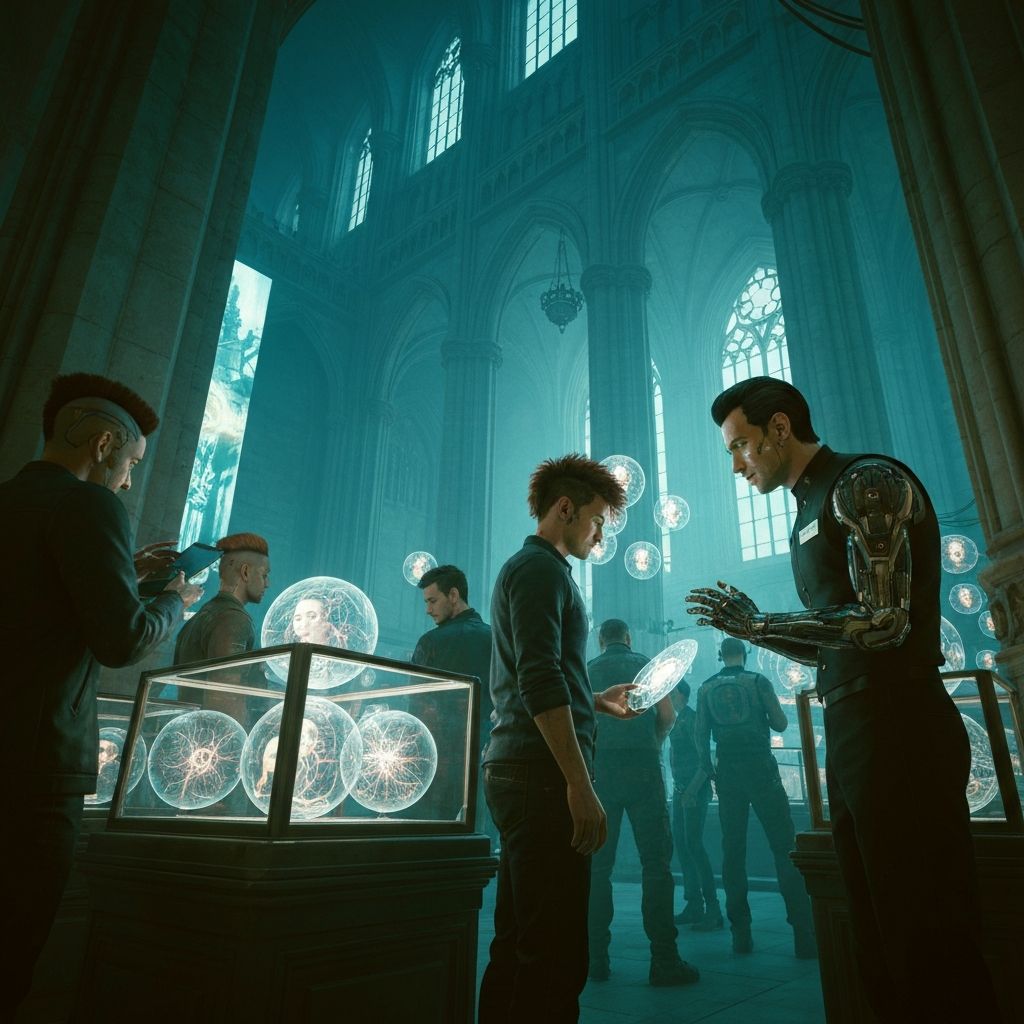
The Memory Exchange occupied a converted cathedral in the old quarter of New Shanghai, its spires replaced with broadcast antennas and its stained glass windows depicting scenes of neural mapping rather than religious iconography. Inside, merchants in sterile white coats conducted the strangest commerce in human history.
"Memories can be bought, sold, and traded," the orientation guide explained to newcomers. "Happy childhood memories are popular gifts for children born into difficult circumstances. Professional skills can be transferred to accelerate training. Traumatic experiences can be extracted and disposed of for those who cannot process them naturally."
"And what about stolen memories?" Zara asked. "Can they be recovered?"
The guide's expression shifted subtly—not quite sympathy, more like professional wariness. "Stolen memories exist in a gray market. They're usually broken down into components—emotional essence separated from factual content, sold to different buyers for different purposes. Recovering intact stolen memories is... rare."
But not impossible.
Zara spent weeks navigating the Exchange's labyrinthine social networks, following rumors and paying bribes, trading what little she had left for information. The trail led her through layers of intermediaries: first the street-level dealers who extracted memories from unconscious victims, then the processors who refined and packaged the stolen goods, finally the distributors who sold to the wealthy and desperate.
She learned that her memories had been valuable—premium product, the dealers said, full of vivid emotional experiences and useful professional knowledge. She had been a memory architect before the theft, designing experiences for the Exchange's legitimate customers. Her skills, her creativity, her capacity for emotional depth—all of it had been harvested and sold.
"Who bought them?" she demanded of a mid-level merchant who owed favors to people she'd helped.
"Several buyers. Your professional skills went to a competitor who wanted to replicate your techniques. Your emotional memories were purchased by a collector—some rich eccentric who wanted to experience falling in love for the first time again."
"And the rest? The everyday memories, the ordinary moments?"
The merchant shifted uncomfortably. "Those were sold as raw material. Broken down into base components, mixed with other extractions, recycled into... new products."
Zara felt something break inside her—a grief for memories she couldn't even mourn because she couldn't remember having them. Three years of her life, reduced to commodity parts.
But as she continued her investigation, she discovered something unexpected. Her memories hadn't been completely destroyed. Small fragments had escaped the breakdown process, showing up in the strangest places—a man in Argentina who suddenly remembered her mother's face, a teenager in Lagos who occasionally dreamed in her voice, a dying woman in Helsinki who experienced unexpected moments of joy that belonged to someone else's life.
Zara began to collect these fragments.
She traveled the world, tracking down every piece of herself that had survived. Each fragment was incomplete, distorted by time and processing, but together they formed a mosaic of the person she had been. She learned that she had fallen in love during those missing years. Had suffered heartbreak. Had experienced professional triumph and personal disaster. Had grown and changed and struggled in ways she would never fully understand.
The final fragment was the hardest to obtain. It belonged to a dying man in a hospice facility in Mumbai—a former memory merchant who had purchased her happiest memory as a comfort for his final days.
"You want it back," he said when Zara found him. His voice was weak but his eyes were clear. "The moment you realized you wanted to spend your life creating memories for others. The moment that gave your work meaning."
"It's mine," Zara said, though she couldn't remember what the moment had felt like. "It was stolen from me."
"Yes. But I've lived with it for months now. It's become part of me too. If I give it back to you, I lose the only truly beautiful thing I've ever possessed."
They sat together in silence as the old man considered his choice. Outside, the Mumbai sunset painted the sky in colors that reminded Zara of emotions she couldn't name.
"Keep it," she finally said. "Keep the memory. Let it be yours."
The dying man wept—tears of gratitude or sorrow or perhaps both. "Why?" he asked.
"Because memories aren't supposed to be possessions. They're supposed to be shared, to connect us, to make us more than we could be alone. What happened to me was a crime, but hoarding what remains won't make me whole again."
She left the hospice having gained something more valuable than any memory: understanding. The person she had been was gone, fragmented and dispersed across a hundred minds. But the person she was becoming—scarred, incomplete, but still creating meaning from chaos—had a future worth building.
Zara returned to the Memory Exchange, not as a victim but as a reformer. She began working to establish protections for people like her, to regulate the extraction trade, to ensure that the commerce in human experience didn't destroy the humanity it claimed to preserve.
Her work attracted enemies and allies in equal measure. Some nights, she lay awake mourning the memories she would never recover. But other nights, she felt something like peace—a sense that identity wasn't stored in the past but created continuously, moment by moment, choice by choice.
She was Zara, memory architect and memory rights advocate. She had lost three years and gained a purpose. And in a world where the contents of minds could be bought and sold, that purpose might be the most valuable thing of all.