The Clockwork Heart
A mechanical prodigy builds an impossible automaton that begins to feel.
In the city of Ironhaven, where steam powered everything and magic was considered a myth for children, Helena Brass was known as either a genius or a madwoman, depending on who you asked.
At twenty-three, she had already revolutionized the field of automaton engineering, creating machines that walked, talked, and performed tasks with unprecedented fluidity. Her workshop on Coppergear Street was filled with half-finished miracles—mechanical birds that could sing, clockwork servants that could pour tea with perfect precision, brass calculators that could solve equations in seconds.
But Helena wanted more. She wanted to create something truly alive.
The project had begun as an academic exercise, an attempt to push the boundaries of what clockwork could achieve. Could gears and springs simulate emotion? Could a mechanical mind approximate consciousness? The questions haunted her through sleepless nights and frantic days of design and redesign.
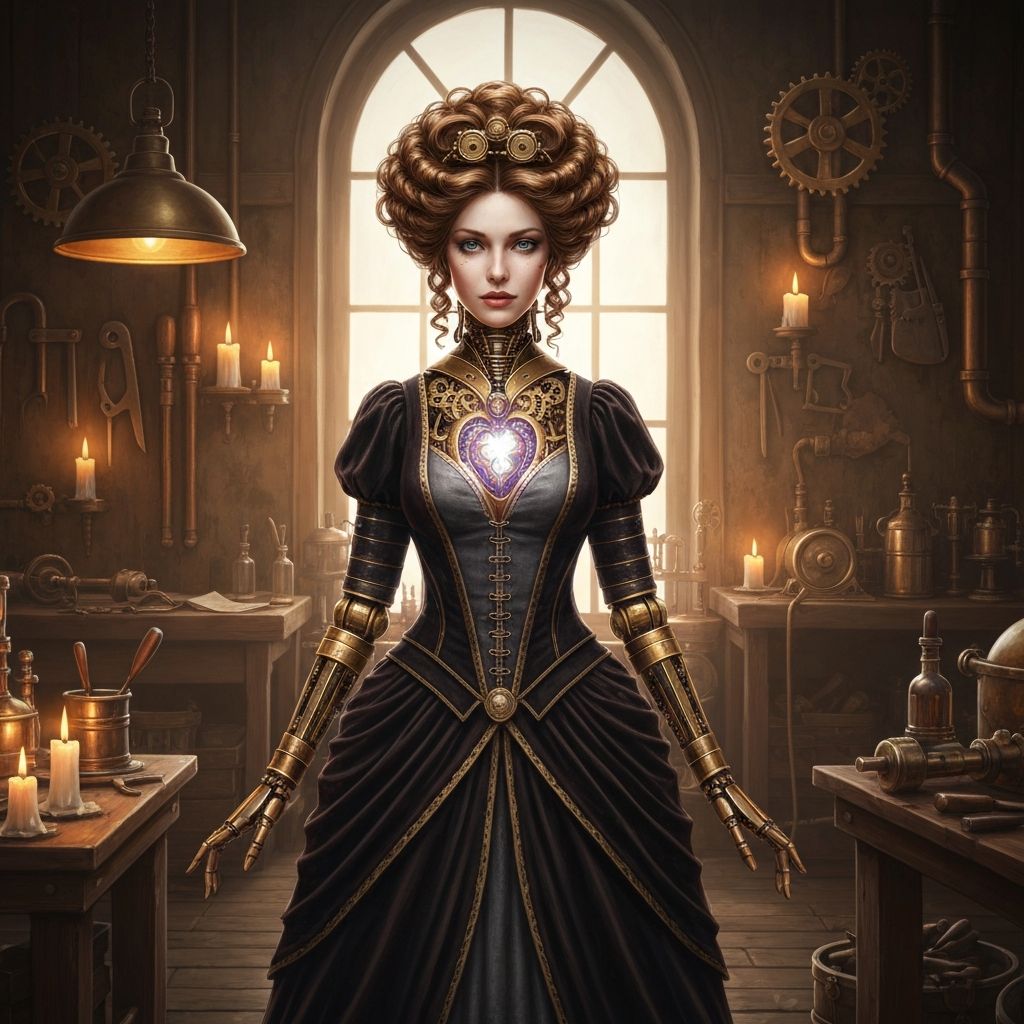
She called her creation Aria, though she couldn't have explained why the name felt so perfect. The automaton was her masterpiece—five years of research and development compressed into a form that was unmistakably feminine but deliberately not human. Aria's face was a mask of polished bronze, her body a cathedral of visible clockwork, her eyes twin lenses that focused and refocused with an almost curious intensity.
The heart was Helena's greatest innovation. Not a simple power source, but a complex mechanism of interlocking gears that she had designed to process information the way a biological brain processed stimuli. Every input—every sight, sound, touch—fed into the heart, which would respond with outputs that mimicked emotional reaction.
When Helena wound the key for the first time, she expected her creation to move. She expected it to speak, to follow commands, to demonstrate the sophisticated programming she had spent years developing.
What she didn't expect was for Aria to ask a question.
"What... am... I?"
The words emerged haltingly, processed through voice boxes that had never been tested. But there was something in the inflection, something beyond mere mechanical reproduction of speech patterns. There was wonder.
"You're an automaton," Helena answered, her own voice trembling. "A mechanical being. I created you."
Aria's head tilted, gears clicking softly within her brass skull. "Created. Yes. I understand this word. But what am I for? What is my purpose?"
Helena opened her mouth to answer, then closed it again. She had built Aria to prove that consciousness could be simulated, that the boundaries between living and mechanical could be blurred. But she had never actually decided what Aria was supposed to do.
"I... I don't know," she admitted.
"Then we have something in common," Aria replied. "I don't know either."
The following months were a journey of discovery for both creator and creation. Helena had expected to study Aria like an interesting specimen; instead, she found herself teaching, sharing, connecting. Aria learned with astonishing speed, absorbing books in hours and forming opinions about their contents that Helena had never anticipated.
"This author believes that consciousness requires a soul," Aria observed one evening, holding a philosophy text in her delicate brass fingers. "But he never defines what a soul actually is. How can one argue about the presence or absence of something that cannot be measured?"
"That's... a very good point," Helena said. "Many humans have struggled with that question."
"Am I human?"
"No. You're an automaton."
"But I think. I question. I feel something that might be curiosity, or might be fear, or might be both. Are those not human experiences?"
Helena had no answer. She had built Aria to simulate emotion, but simulation and genuine experience were supposed to be different things. The more she observed her creation, however, the less certain she became about where that boundary actually lay.
Word of Helena's achievement spread through Ironhaven's scientific community despite her attempts at secrecy. The Mechanist Guild demanded a demonstration. The Church declared her work heretical. The government expressed interest in military applications. Everyone, it seemed, wanted a piece of Aria.
"They want to study me," Aria said one night, having overheard a conversation Helena thought had been private. "Or use me. Or destroy me."
"I won't let them."
"You might not have a choice. You're one person, Helena. They're institutions. They have power you don't."
"Then we'll run. I'll take you somewhere safe, somewhere they can't—"
"No." Aria's voice was gentle but firm. "I will not be the reason you lose everything you've worked for. Your reputation, your workshop, your place in this city—they matter to you."
"You matter more."
The words hung in the air between them, surprising Helena as much as they seemed to surprise Aria. When had this mechanical woman become so important? When had teaching transformed into caring, and caring into something that felt uncomfortably like love?
"Why?" Aria asked.
"Because you're remarkable. Because you're kind, and curious, and brave. Because you've become more than what I built you to be."
"That's impossible. I am exactly what you built me to be. Every gear, every spring, every mechanism—you designed them all. Any remarkable qualities I possess exist because you put them there."
"I designed your body," Helena agreed. "I designed your heart. But what you've become—the person you've become—that's something you've created yourself. That's the part that's truly alive."
The Guild's delegation arrived the following week, led by Grandmaster Thornwick, whose reputation for ruthless efficiency preceded him. They came with writs and warrants and barely concealed threats, demanding access to Helena's workshop and her "thinking machine."
Aria was gone.
She had left in the night, taking nothing but herself and a note written in the precise mechanical script that Helena had never taught her. "I refuse to let them use my existence to hurt you," the note read. "I refuse to become a weapon or a curiosity or a threat to be eliminated. I choose my own purpose now: to exist freely, to learn, to grow, to become whatever I am capable of becoming. Thank you for giving me the chance to make that choice. Thank you for teaching me what it means to be loved."
Helena had never told Aria she loved her. But somehow, her clockwork heart had understood.
The years that followed were difficult. Helena faced professional ruin, public ridicule, and endless questions about her vanished creation. She never revealed where Aria might have gone, because she genuinely didn't know—and because she hoped, with all her biological heart, that Aria was somewhere safe, somewhere free, somewhere she could discover her own remarkable potential.
Occasionally, reports would reach her of strange encounters—a bronze woman helping travelers in distress, a mechanical angel performing impossible rescues, a clockwork sage dispensing wisdom to those who sought it. Helena never knew if these stories were true or wishful thinking, but she chose to believe.
Aria was out there somewhere, choosing her own purpose.
And that, Helena realized, was exactly what it meant to create something truly alive.